México is currently facing a housing crisis. On July 4th, an assembly convened to discuss the effects of gentrification in México City—originally planned at Parque México, in the Condesa neighborhood—turned into an improvised protest march, where a crowd expressed frustration with the country’s housing crisis. The media quickly reduced the entire event to a single gesture: the symbolic expulsion of gringos and a few acts—labeled as vandalism—against local businesses. What did Starbucks ever do? What about El Califa? Won’t someone think of the shattered windows at Sport World? Headlines clung to this conveniently scandalous image, while the deeper, less photogenic demands were pushed aside.
Many voices in the media and on social media revealed a clear undercurrent of classism and racism: “If they want to live in Roma or Condesa, they should work harder (and complain less),” “They’re just a bunch of resentful freeloaders, enemies of entrepreneurship and Sunday brunch,” “The gringos help us, they uplift us, they civilize us—this is what living in NYC must feel like.”
However, other voices also emerged—more balanced ones—that spoke out about what most media outlets chose to ignore: that México is in the midst of a deep and multifaceted housing crisis. What are some of the causes affecting México City in particular? Is it solely the presence of Americans and Europeans? In my view, it would be naive to deny that they’ve helped destabilize the rental market in the country, bolstered by structural inequality in access to resources. They arrive as so-called “digital nomads”—so-called because it’s no longer just about working remotely, but also about acquiring property, opening businesses, and exercising new forms of territorial control. It’s a form of neocolonialism, even if unintentional. One example is MJH, an American I met in México City with whom I’ve shared many conversations during my time in the United States. More than once, with a visionary tone, he told me his dream was to buy and renovate a building in Roma or Condesa, rent it out on Airbnb, and travel the world. Capital gain as a life plan… and, why not say it, also a bit of white privilege disguised as wellness discourse. That’s why the Palestinian flags at the protest came as no surprise: that symbol wasn’t out of place, but rather in dialogue with a broader discourse on new forms of colonization.
Still, despite all of this, they are not the problem—merely a symptom. As Carla Escoffié—lawyer and housing rights activist—has pointed out, gentrification is not a conflict between nationalities, but an expression of structural inequalities that have been festering for years: lack of rent regulation, absence of social housing policies, normalized real estate speculation, and a State that, instead of regulating, facilitates the transformation of the city into a business. Yes, foreigners arrive—but they do so in a city that was already prepared to receive them: a city where living has become an obstacle course, and renting, a privilege.
Moreover, gentrification doesn’t happen solely because of foreigners. Mexicans gentrify, too. Because, in truth, this isn’t a migration issue—the history of cities is, by definition, a history of migrations—but a class issue. What matters is not where the newcomer comes from, but whom they displace and under what conditions. People’s lives aren’t improved; they are simply relocated—often forcibly—and in many cases, their living conditions worsen.
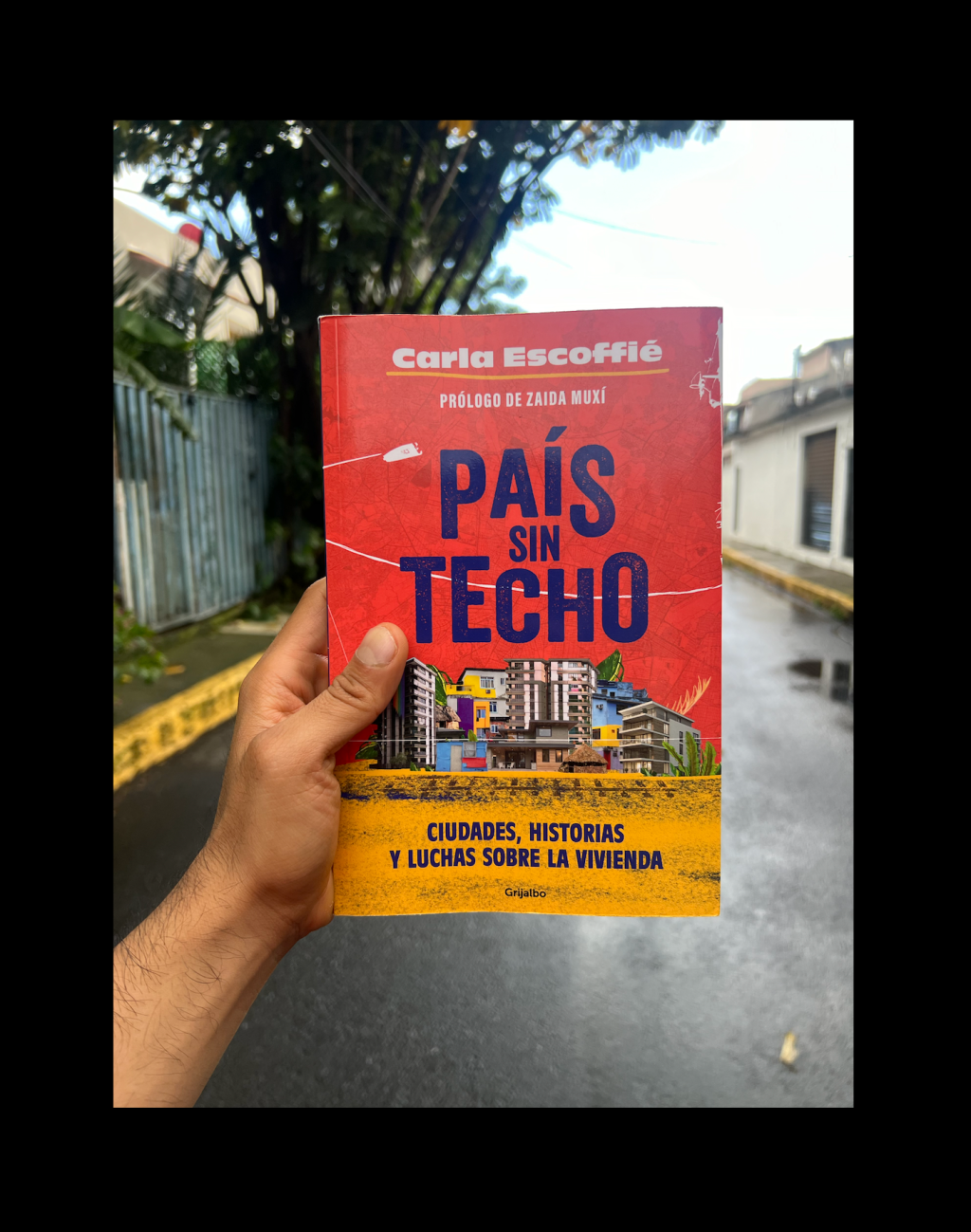
After the events of the march, I felt the need to understand better what was happening in México, not just in the streets, but in the foundations of that unrest. One of the most valuable resources I found was the book País sin techo (A Country Without a Roof), written by Carla Escoffié—one of those voices worth listening to. The book offers a broad overview of the many fronts that make up the housing crisis in México: speculation and real estate bubbles, as in Mérida; megaprojects turned into territorial loot, as in Campeche; the lack of regulation and tenancy laws in México City, which—contrary to popular belief—is not always at the forefront of rights; the discrimination faced when renting or buying property, as experienced by LGBTQ+ people in San Luis Potosí; or the growing informal settlements on the outskirts of Monterrey.
As Carla notes at the end of her book, País sin techo does not attempt to cover every issue, because there are many, and they’re complex. Nor does it offer a single solution, because none exists. It proposes the need for multiple responses working together, across legal, social, political, and community-based fronts. Her approach calls for an integral perspective, one that understands that housing is not resolved through goodwill or empty development speeches, but through sustained public policy, political will, and, above all, justice.
So, what comes next for México City? That remains to be seen. For now, we must stay informed, question not only the government but also our own assumptions about space, the city, and who has the right to inhabit it. País sin techo—Carla Escoffié’s book—can be a first step for those of us who, like me, had overlooked the depth of this crisis—perhaps out of ignorance, perhaps out of comfort. Read, listen, question. Because while there may be no single solution, there are many paths we can begin to follow. And perhaps the first step is to stop seeing housing as a commodity… and start defending it for what it truly is: a right that belongs to all of us.


 Uriel González-Bravo
Leave a comment