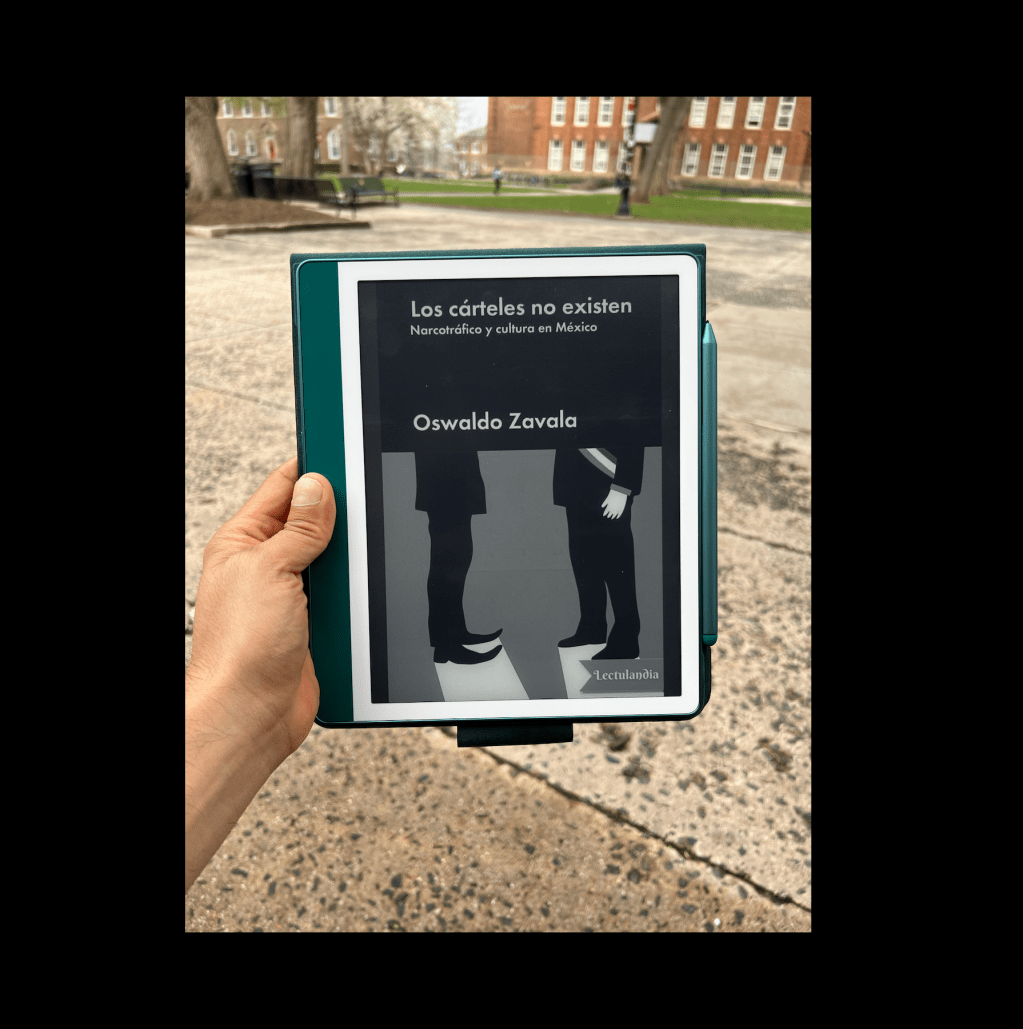
Most of us, in one way or another, believe we know what drug trafficking is about. Literary works, the media, television series, and even some journalistic books have given us a particular image of what “narco,” “cartels,” “territories,” and all the language used to describe the illegal drug trade mean. In The Cartels Do Not Exist: Drug Trafficking and Culture in Mexico, Oswaldo Zavala aims to question that dominant narrative and to place drug trafficking back into the geopolitical and social context from which it has been removed—often to present it as something autonomous, separated from the State and global politics, when in fact it is profoundly shaped by both.
The figure of the “narco” is often presented as an external threat that corrupts the State and terrorizes society. However, Zavala argues that this figure has been constructed through official discourse. Terms like “cartel” or “plaza” (a word used in Mexico to refer to territories controlled by criminal groups) are discursive inventions legitimized by state institutions and reproduced by the media, literature, films, and TV shows. This language prevents us from seeing that organized crime does not operate outside the State but has historically been managed and disciplined by it.
Contrary to the narrative that portrays cartels as groups that have “overpowered” the State, Zavala shows that violence tends to erupt after the military enters certain regions of the country—not before. Militarization creates the terror that helps justify territorial control, the displacement of communities, and the entry of foreign investment. In this sense, violence is not a side effect of drug trafficking but a tool of governance. What happens in places like Ciudad Juárez is not simply a war between cartels but a reconfiguration of state power under a neoliberal logic.
The image of the “all-powerful narco” serves a clear function: to conceal the true centers of power. By portraying traffickers as enemies of the State, the official narrative hides the fact that organized crime has historically worked in ways that are functional to state structures. As Zavala explains, accepting this narrative limits our ability to think critically about political power. The “war on drugs” then becomes a strategy for control, dispossession, and the legitimation of state violence.
Zavala also argues that the narrative of drug trafficking cannot be understood without considering the role that the United States has played in shaping it. Since the Cold War, the U.S. government has promoted the idea of a “war on drugs” as part of its foreign policy in Latin America. From the creation of the CIA in 1947 to Operation Condor in the 1970s and the more recent Mérida Initiative—a bilateral security agreement between the U.S. and Mexico—drug trafficking has often served as a justification to maintain military and surveillance control over strategic areas, while also promoting economic policies that benefit transnational capital.
In this context, Zavala identifies three key historical moments in the relationship between drug trafficking and the Mexican State. The first is the period of the Institutional Revolutionary Party (PRI), from the 1970s to the 2000s, when the federal government exercised strong centralized power and kept criminal groups under strict control. The second moment came under President Vicente Fox (2000–2006), the first Mexican president from the conservative National Action Party (PAN), whose administration saw a weakening of federal power and more autonomy for local and regional actors. The third moment corresponds to the presidency of Felipe Calderón (2006–2012), also from the PAN, who launched a military campaign against drug trafficking that significantly increased the presence of the armed forces across the country.
According to Zavala, this “war” was not aimed at eliminating cartels but at recovering the State’s control over territories through militarization. In all these cases, drug trafficking appears not as a real threat to the State but as a functional excuse to redefine power relations—within and beyond Mexico.
By questioning the official narrative of drug trafficking, The Cartels Do Not Exist offers a political reading of the phenomenon that places the State at the center of the production of violence, control, and symbolic order. Zavala does not deny that drug trafficking exists or that there are actors involved in it. He questions how these actors have been represented in a way that justifies military interventions, security strategies, and forms of territorial dispossession. In a country where the word “narco” is used to explain (and justify) almost everything, this book provides a necessary starting point to rethink what we know—or think we know—about power and violence in Mexico. I invite readers to read it not to find simple answers but to ask better deeper questions.


 Uriel González-Bravo
Leave a comment